
The Most Anabolic Part of Your Workout Is Not the Workout
The most anabolic part of your workout is not the workout. It is what you do in the first recovery window after it.
A lot of people put all of their attention on the training session and almost none on what happens right after. That is a mistake.
Mechanical tension creates the opportunity. What you do after the workout helps decide how much of that gets turned into repair, glycogen restoration, and adaptation.
After training, skeletal muscle is not in its normal state. Muscle contraction increases GLUT4 translocation through insulin-independent pathways, and post-exercise muscle becomes more insulin-sensitive, which improves glucose uptake into the tissue that just did the work. why I like a deliberate protein-plus-carbohydrate recovery meal instead of acting like protein is the whole story.
Protein and Carbohydrate Are Not Doing the Same Job
This is where a lot of people get lazy with the conversation.
Protein and carbohydrate are not interchangeable in the post-workout window.
Protein supplies the amino acids needed for repair, remodeling, and muscle protein synthesis. Carbohydrate helps restore the glycogen you just burned and takes advantage of the post-workout state where muscle is unusually efficient at pulling glucose inward. Reviews in sports nutrition support protein alone or protein-plus-carbohydrate after exercise, with carbohydrate becoming especially relevant when glycogen restoration and recovery speed matter. e after training is simple:
45 grams of protein
1/4 cup gluten-free oats
As soon as practical after the session
Not because oatmeal is magic.
Because the body has two jobs to do after training:
rebuild muscle
refill glycogen
Protein helps rebuild.
Carbohydrate helps refill.
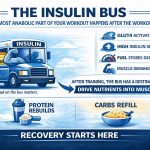
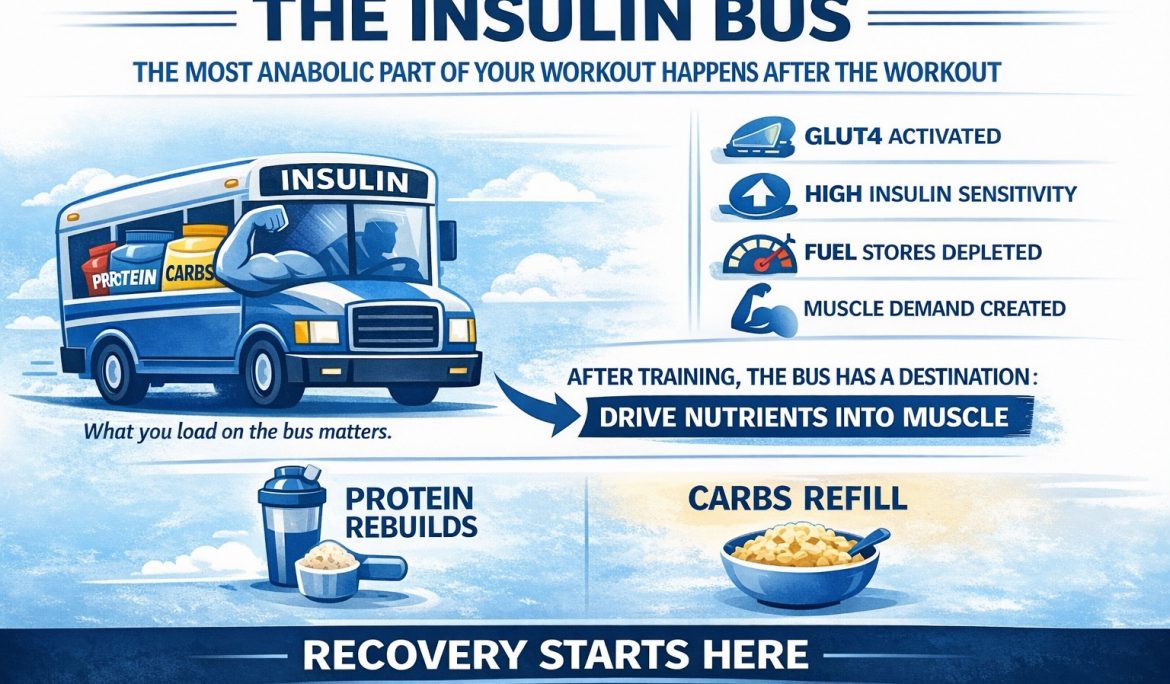
The Insulin Bus
This is where I use the insulin bus analogy.
If you are going to create an intentional insulin spike after training, you need to be intentional about what you load on that bus.
A random insulin spike in a sedentary body is one thing.
A post-workout insulin spike is different.
After training, muscle has already created demand. GLUT4 has already moved. Insulin sensitivity is higher. Stored fuel has already been used. That changes the context completely. eful to go.
That is the whole point.
The post-workout meal is not just about eating calories. It is about taking advantage of a moment when the tissue you just trained is more prepared to use what you give it.
Is Protein Alone Enough?
This is the question that usually comes up next.
Yes, protein alone can still stimulate muscle protein synthesis. That part is true.
But protein alone does not do the whole job as well as protein plus carbohydrate when recovery and glycogen repletion matter.
If all you take is protein, you may still support muscle growth. But now you are asking one substrate to carry more of the recovery burden while glycogen restoration lags behind. Protein alone can help you rebuild. Protein plus carbohydrate helps you rebuild and refill. ot Use Vegetables in That Window
This is also where people confuse general longevity eating with post-workout recovery eating.
Those are not the same meal.
Vegetables absolutely matter. They matter for fiber, polyphenols, satiety, gut health, and long-term metabolic health.
But right after training, I am not trying to build the perfect all-day longevity plate.
I am trying to do two things quickly:
- rebuild muscle
- refill glycogen
That is why I usually choose a small strategic carb source like oats in that window instead of vegetables. Vegetables have a place. They are just not the best tool for that specific job.
This Is Not Bro Science When You Understand the Physiology
A lot of people dismiss this conversation as bodybuilding talk.
That is lazy.
This is not bro science when you actually understand the physiology behind it.
Post-exercise muscle is more insulin-sensitive. Glucose uptake is improved. Glycogen restoration matters. Amino acid delivery matters. The body is not in the same metabolic situation it was in before the session started. ikes all day.
I am saying the post-workout window is one of the times where a deliberate insulin spike paired with the right nutrients can be used intelligently.
That is a very different conversation.
The Bigger Point
A lot of people are not undertrained.
They are under-recovered.
They train hard enough to create the demand, but they do not recover in a way that gives muscle first claim on the incoming fuel.
That is why the post-workout window matters.
Not because 31 minutes ruins your results.
Not because oatmeal is magical.
Not because insulin is the hero of the story.
It matters because what you do after the workout helps determine how much of that session gets turned into something useful.
Train hard enough to create the demand. Then recover in a way that gives muscle first claim on the incoming fuel.
FAQ section
Is protein alone enough after a workout?
Protein alone can stimulate muscle protein synthesis, but adding carbohydrate can improve glycogen restoration and recovery, especially when training volume is high or the next session is coming soon.
Why add carbs aftn and take advantage of the fact that post-exercise muscle is temporarily better at glucose uptake.
What is a simp with a small strategic carb source such as 1/4 cup gluten-free oats.
Are vegetables the best carb source after a workout?
Vegetables are valuable overall, but right after training they are usually not the most efficient tool if your main goal is quicker glycogen replacement and recovery.