The Spark Isn’t Gone. The Signal Is.
A clinician’s guide to restoring desire—plus where O-Shot® and P-Shot® fit (and where they don’t).
I’ve sat with countless women in their forties and fifties—sharp executives, devoted mothers, creative powerhouses—who whisper, “I love my partner, but the spark is gone. Is this just… me now?” They brace for judgment or a quick prescription. I show the labs and say: your desire isn’t broken; your biology is unbalanced.
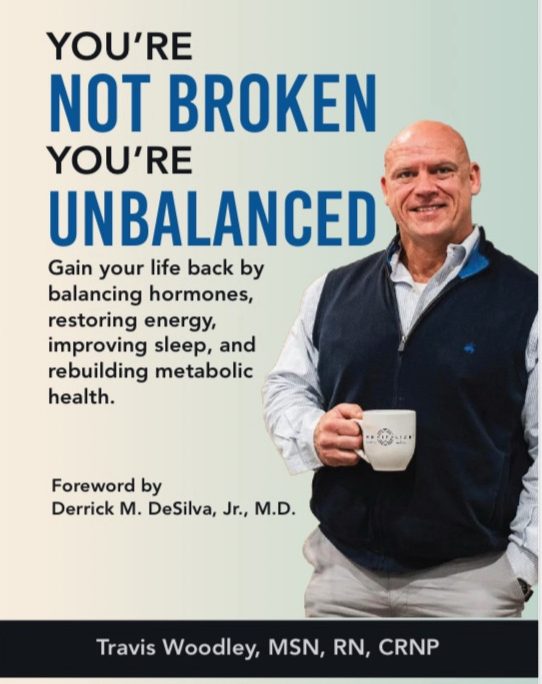
Chapter 16 of You’re Not Broken—You’re Unbalanced treats sexual health as a vital sign—a reflection of hormone signaling, blood flow, brain wiring, and the daily rhythm of stress and recovery. Restore the signal and intimacy often returns as a byproduct of feeling fully alive.
How desire actually works
-
Dopamine drives wanting.
-
Testosterone adds pursuit and physical “go.”
-
Oxytocin builds safety and attachment.
-
Estrogen sharpens sensation and supports resilient vaginal tissue.
-
Progesterone calms the nervous system so “yes” feels safe.
-
Thyroid sets the body’s tempo.
When cortisol hijacks the dashboard—think 3 a.m. wake-ups and racing thoughts—the system shifts to survival. Libido is postponed. Arousal becomes optional. Orgasm fades into memory.
A true story: Elena & Marcus
She’s 48; he’s 52. Night sweats. Flat mornings. Erections fading. “We’re roommates.”
Her labs: estradiol low, progesterone erratic, testosterone low.
His labs: testosterone drifting down, estradiol high from visceral fat, insulin creeping. Sleep in pieces.
What we did—in order
-
Rebuilt rhythm: lights out by ten, morning sunlight, protein-anchored meals.
-
Personalized hormones: estradiol + progesterone for her (plus local estriol for tissue and pH); thoughtful, monitored testosterone for her; measured testosterone for him with follow-up.
-
Resolved inflammation: therapeutic omega-3s and specialized pro-resolving mediators.
-
Repaired the gut: targeted immunoglobulins + glutamine to reduce bloat and improve absorption.
-
Used precise adjuncts when appropriate: a melanocortin pathway option for arousal (with monitoring), and a growth-hormone–releasing blend to deepen sleep and recovery.
Six weeks later: sweats gone, energy up, spontaneous hiking dates, slow dancing in the kitchen. Sex wasn’t scheduled—it was celebrated. “We fell back in love because we finally had bandwidth again.”
Where do O-Shot® and P-Shot® fit?
Short answer: After the foundations. Both are platelet-rich plasma (PRP) procedures using your own blood’s growth factors; they’re designed to support microvascular flow, nerve signaling, and tissue quality.
-
O-Shot® (for women). PRP is placed into targeted vaginal/clitoral tissues to support sensitivity, lubrication, and comfort. Many women report improvements; it’s best as an adjunct once hormones, sleep, and gut health are addressed. Learn more on the official O-Shot® site. O-Shot® (Orchid Shot® )
-
P-Shot® (for men). PRP is injected into penile tissues with the aim of supporting erectile quality and sensation. It is used adjunctively alongside lifestyle, vascular care, and appropriate medical therapy. Official information is available here. Priapus Shot®
A realistic evidence view
Early studies and reviews suggest potential benefits of PRP for female sexual function and stress urinary incontinence, but data quality is mixed and sample sizes are modest. OUP Academic+1
For erectile dysfunction, systematic reviews and urology briefings describe promising but inconclusive results; major societies emphasize standard evaluation and guideline-based care first. World Journal of Men’s Health+2PLOS+2
Safety, sourcing, and standards
Because PRP is autologous, systemic risks are low, but technique and sterility matter. Only work with certified clinicians using medical-grade PRP systems and strict infection-control protocols; news investigations show why this matters. AP News
Practical levers that move the needle
For women: local estrogen for elasticity, lubrication, and pH; carefully monitored low-dose testosterone for spontaneous desire; optimize thyroid function; pelvic-floor therapy with hyaluronic-acid support for pain after childbirth or endometriosis.
For men: protect testosterone with seven-and-a-half to eight-and-a-half hours of sleep, resistance training, and vascular care; reduce abdominal fat to curb aromatase (testosterone → estradiol).
For both: align sleep, meals, and training to restore cortisol rhythm; build an “us hour” with touch and no goal; try a thirty-day dopamine reset—no pornography and no doom-scrolling—to resensitize the brain to real-world novelty.
Screen first. Source well.
Assess cardiovascular risk, prostate markers, hematocrit, thyroid and iron status, gut health, and estrogen metabolism. Vet every intervention. Track outcomes that matter: comfort, desire, arousal, orgasm, connection.
Bottom line: sexual health isn’t a side quest. It’s the scoreboard of metabolic resilience. When the body feels safe, fueled, and clearly signaled, desire doesn’t need pep talks—it shows up.
Want to go deeper?
This post distills Chapter 16 of You’re Not Broken—You’re Unbalanced. If you’re a podcast host, let’s have the candid, evidence-based conversation your audience is waiting for.
Further reading and provider information:
• O-Shot® official site (overview, mechanism, providers). O-Shot® (Orchid Shot® )
• P-Shot® official site (overview, mechanism, providers). Priapus Shot®
• Clinical summaries and reviews of PRP in women’s sexual health. OUP Academic+1
• Evidence outlook for PRP in erectile dysfunction. World Journal of Men’s Health+1
Educational content only. Partner with a qualified clinician who knows your history.