
The Biohack Almost Everyone Misses: Your Airway at Night
Cold plunges. Red light. Peptides. GLP-1s. Fancy wearables.
I see all of it.
And I’m not against any of it.
But if you snore, choke, wake up gasping, grind your teeth, or wake up feeling like you got hit by a truck after “sleeping” all night, your biggest biohack is probably not in your freezer, on your wrist, or in your supplement cabinet.
It’s your airway.
That may not be flashy. It may not be something people want to talk about. Nobody is posting selfies with their CPAP. But from a functional medicine and metabolic health standpoint, airway health is one of the most overlooked reasons people stay stuck.
And I see it in clinic all the time.
The Pattern I Keep Seeing
A lot of the men and women I work with are doing almost everything right.
They’ve cleaned up their food.
They’re strength training.
They’re walking more.
They’re taking creatine, magnesium, and targeted supplements.
Some are already on testosterone, thyroid support, peptides, or GLP-1s.
And they still feel awful.
They tell me:
-
“My brain fog hits hard by mid-afternoon.”
-
“The fat around my middle will not move.”
-
“My blood pressure is creeping up.”
-
“My drive and libido are flat.”
-
“I wake up feeling hungover, and I didn’t even drink.”
-
“My labs are normal, but I know something is off.”
That is when I ask a question that changes the whole case:
Do you snore?
Or, better yet:
Has your partner ever told you that you stop breathing, gasp, choke, or thrash around in your sleep?
That is when the story usually opens up.
You Are Not Sleeping. You Are Surviving the Night.
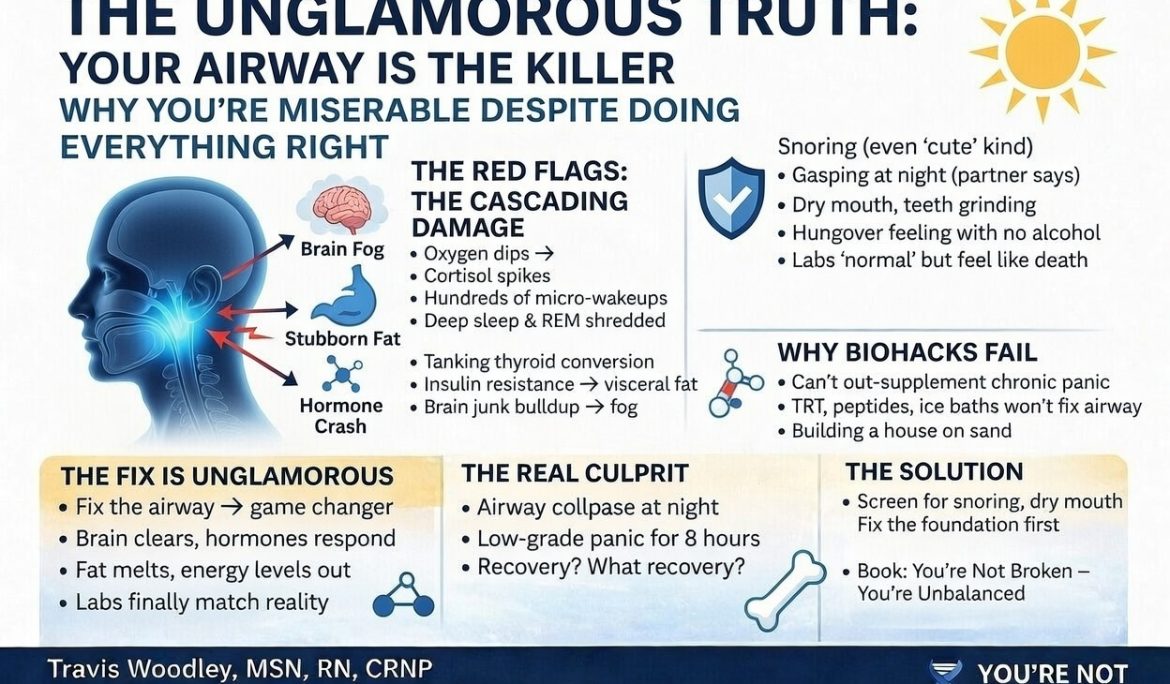
When the airway collapses over and over again during sleep, the body does not get the deep restoration people think it is getting.
It gets stress.
Oxygen drops.
Cortisol rises.
Adrenaline kicks in.
The brain partially wakes up.
Then it happens again.
And again.
And again.
Most people do not remember those micro-awakenings, but the body does.
So while someone thinks they were “in bed for eight hours,” their nervous system spent the night in a low-grade survival response.
That changes everything.
Why Airway Health Matters So Much in Functional Medicine
From a functional medicine clinic point of view, the airway belongs in the same conversation as hormones, gut health, inflammation, mitochondria, and metabolic health.
Why?
Because sleep-disordered breathing wrecks the exact systems we are trying to optimize.
1. It crushes deep sleep and REM sleep
Deep sleep is where some of the heaviest repair work happens. This is when growth hormone pulses, tissue repair ramps up, and the brain’s drainage system begins clearing out waste.
REM sleep matters too. This is where the brain works through memory, mood regulation, emotional processing, and cognitive integration.
When the airway keeps collapsing, both of those stages get disrupted.
That means people do not just wake up tired. They wake up unrepaired.
2. It interferes with hormone signaling
If someone is spending the whole night in a stress response, it is no surprise that hormone signaling starts to break down.
This is where I see:
-
testosterone that looks “low-normal” but feels awful
-
poor thyroid conversion, especially T4 to T3
-
elevated cortisol patterns
-
insulin resistance getting worse over time
-
stubborn visceral fat that does not respond the way it should
People often think their hormone therapy “isn’t working” when the truth is their body is fighting for air every night and never entering a true recovery state.
3. It drives brain fog and poor cognitive performance
When sleep is fragmented, oxygen is unstable, and stress hormones surge all night, the brain pays the price.
People describe it as:
-
slow recall
-
word-finding problems
-
poor focus
-
irritability
-
anxiety
-
feeling mentally “dull”
-
waking up with that hungover feeling even though there was no alcohol involved
That is not laziness.
That is not aging.
That is not a motivation problem.
That is physiology.
4. It makes metabolic health harder than it should be
I see a lot of people blaming themselves for weight loss resistance when the body has been under nighttime stress for years.
If insulin sensitivity is falling, cortisol is climbing, sleep is broken, and oxygen is dipping, the body is going to hold onto fat — especially around the middle.
That is why some people can do “all the right things” and still feel like they are pushing a car uphill.
The Clues Are Usually There
Airway issues do not always show up as someone dramatically waking up gasping.
Sometimes the clues are quieter.
Here are some of the things that make me think about sleep-disordered breathing early:
-
snoring, even the “not that bad” kind
-
dry mouth in the morning
-
grinding teeth
-
waking up multiple times to urinate
-
morning headaches
-
feeling exhausted despite being in bed for 7–8 hours
-
needing caffeine just to feel normal
-
crashing in the afternoon
-
“normal” labs with symptoms that do not add up
If those things are present, I do not treat airway as an afterthought.
I put it right next to the rest of the case.
What Changes When You Actually Fix the Airway
This is the part people rarely hear.
When you identify the airway problem and actually address it, a lot of the “mystery symptoms” start moving in the right direction.
Not because you found a magic trick.
Because you removed a constant physiological stressor.
This is when people come back and say:
-
“My brain feels like it came back online.”
-
“My hormones finally seem to be landing.”
-
“The weight around my middle is finally shifting.”
-
“My energy is steady instead of all over the place.”
-
“For the first time, my labs actually match how I feel.”
That is a huge deal.
And it is why I keep saying this is one of the most under appreciated areas in metabolic medicine.
How I Think About It in Practice
I do not look at airway in isolation.
I look at it as part of the larger metabolic picture.
That means I am thinking about:
-
symptoms and sleep quality
-
snoring and partner observations
-
hormones
-
thyroid
-
cortisol
-
insulin resistance
-
body composition
-
inflammation
-
nervous system tone
-
recovery capacity
From there, the next steps may include sleep testing, airway evaluation, working with sleep specialists, ENT, dentistry, or considering treatment options that actually match the person in front of me.
But the first step is simply this:
Take it seriously.
Do not minimize it.
Do not laugh it off.
Do not call it “just snoring.”
This Is the Part of Health Optimization Nobody Brags About
People love talking about advanced stacks, new peptides, and expensive gadgets.
But for a lot of people, the real unlock is not another tool.
It is sleep that actually repairs them.
It is oxygen that actually stays stable through the night.
It is a nervous system that is not being dragged through a threat response for eight hours straight.
That is not glamorous.
But it is real.
And it changes lives.
Why I Talk About This So Much
This is one of the reasons I wrote You’re Not Broken – You’re Unbalanced and one of the reasons we built Rebuild Metabolic Health Institute the way we did.
You cannot talk about metabolic health without talking about sleep.
And you cannot talk about sleep without talking about the airway.
If someone is “doing everything right” and still feels half-alive, this is one of the first places I want to look.
Because sometimes the missing link is not more effort.
Sometimes it is air.
Want to Go Deeper?
If this sounds like you, or like someone you know, here are a few places to start:
Read the book:
You’re Not Broken – You’re Unbalanced
Amazon: https://www.amazon.com/Youre-Not-Broken-Youre-Unbalanced-rebuilding/dp/B0FQJNQ6XP/ref=tmm_pap_swatch_0
More book platforms:
https://books2read.com/Youre-not-broken
Learn more about Rebuild Metabolic Health Institute:
https://rebuildmetabolichealth.com/rebuild-metabolic-health-institute/
Resources and newsletter:
https://rebuildmetabolichealth.com/