

What the FDA’s Testosterone Panel Really Means for the Future of Men’s Health
Yesterday’s FDA advisory panel on testosterone didn’t just debate a label. It marked the beginning of the end of a 30-year story that has shaped how men age in this country.
For most of that time, the message has been:
“Testosterone is dangerous. Use it rarely. Avoid it in aging men.”
That narrative is finally starting to break.
This post is not personal medical advice. It’s how I, as a clinician who works with men’s hormones and metabolic health every day, interpret where we’ve been and where we are going.
How We Got Here: From Core Hormone to Controlled Substance
Testosterone has been in our medical toolbox since the 1930s. For decades it was treated, like thyroid hormone, as a legitimate therapy for:
-
Hypogonadism
-
Delayed puberty
-
Certain anemias and other specific conditions
That changed with the Anabolic Steroids Control Act of 1990. In the middle of sports scandals and steroid panic, testosterone was grouped with anabolic steroids and moved into Schedule III of the Controlled Substances Act.
The intention was to curb abuse in athletics and bodybuilding. The fallout for regular men looked very different:
-
Physiologic testosterone replacement was lumped in with doping.
-
Prescribing carried extra paperwork, oversight, and stigma.
-
Many clinicians looked at the climate and decided it was safer—for them—to just say no.
Meanwhile, the demand didn’t disappear. It moved.
Men with real symptoms were told their numbers were “normal for age,” while a parallel gray and black market grew: gym vials, underground labs, overseas pharmacies, and online “protocols” with no real monitoring.
We didn’t eliminate risk. We pushed it out of the exam room and into the shadows.
The Cardiovascular Whiplash
Layered on top of that was a decade of cardiovascular fear.
Small, conflicting studies raised alarms about heart attack and stroke risk with testosterone replacement. In 2015, the FDA responded with tight labeling and strong cardiovascular warnings. Many clinicians backed even further away.
Eventually, we got the kind of study we should have had from the beginning: large, randomized, placebo-controlled outcomes trials in the right population.
Trials like TRAVERSE asked the real-world question:
In properly diagnosed men at elevated cardiovascular risk, does testosterone therapy increase major adverse cardiovascular events—or not?
The answer was more nuanced than the headlines:
-
Testosterone was non-inferior to placebo for major cardiac events.
-
There were specific safety signals—atrial fibrillation, pulmonary embolism, among others—that deserve respect and monitoring.
On the strength of these data, the FDA has already:
-
Removed the class-wide boxed cardiovascular warning about heart attack and stroke.
-
Updated labels to emphasize blood pressure monitoring and a more detailed, data-driven discussion of risk.
Not “testosterone is safe for everyone.”
But no longer “testosterone automatically equals a heart attack.”
That matters.
What the December 2025 Panel Actually Said
The December 2025 advisory panel took the next logical step.
Based on the reports and discussion, the panel:
-
Recommended removing testosterone from Schedule III—de-scheduling it as a controlled substance to reduce barriers to legitimate care.
-
Urged the FDA to move beyond the tiny box of “testicular or pituitary failure only” and recognize age-related and metabolic hypogonadism as real medical problems.
-
Framed men’s health as a national crisis: declining life expectancy, cardiometabolic disease, depression, low vitality, and lack of engagement with preventive care.
In other words, they basically said:
Our current regulatory posture is still stuck in 1990’s steroid panic, not in 2025’s data.
The panel is advisory.
The FDA and DEA still have to act.
But in regulatory culture, this kind of panel is a clear signal that the center of gravity is shifting.
What Schedule III Has Meant for Men in Real Life
In my clinic, Schedule III has never been just an abstract legal classification. It’s shown up as men in their 40s, 50s, and 60s who look and feel like this:
-
Increasing belly fat, decreasing muscle
-
Poor recovery from workouts
-
Flat mood, low drive, and brain fog
-
Snoring, poor sleep, rising blood pressure, prediabetes or diabetes
They finally work up the courage to ask about testosterone and hear:
“You’re fine. You’re just getting older.”
Some accept that and quietly deteriorate.
Others go looking for answers and end up with:
-
“Low T” chains that adjust numbers but ignore the rest of the system
-
Self-directed protocols from forums and gym buddies
-
No real oversight of blood pressure, hematocrit, lipids, or prostate health
That is the unintended consequence of Schedule III and fear-based messaging: we pushed a lot of men away from supervised care and into improvisation.
What the Next Era of Men’s Health Should Look Like
The real question isn’t just what the FDA might do next. It’s what we, as clinicians and as patients, decide to do with this opening.
If the advisory panel’s recommendations are followed—modernized indications, de-scheduling, updated labeling—we’ll have a rare chance to rebuild men’s health care from first principles.
This is how I believe it should look, and how we already practice at Rebuild Metabolic Health Institute.
1. Treat testosterone as a systems hormone
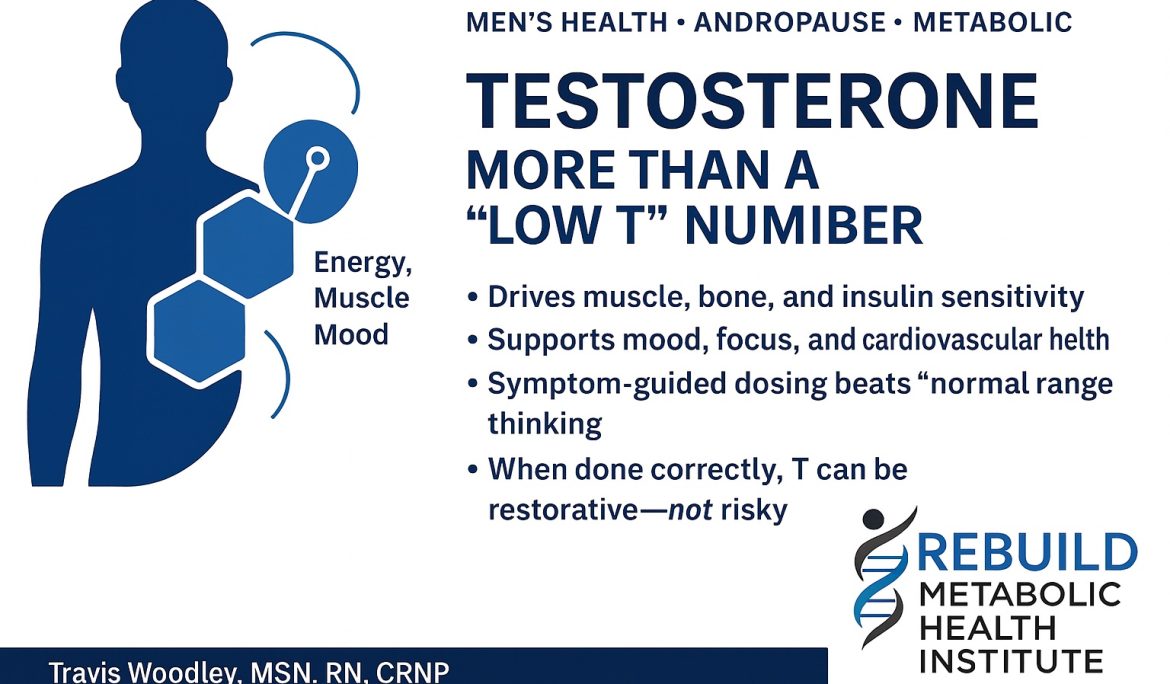
At Rebuild, testosterone is never a “beach body drug.”
We use it to support:
-
Skeletal muscle as a metabolic and endocrine organ
-
Visceral fat reduction and insulin sensitivity
-
Bone density and fracture risk
-
Mood, drive, and cognitive function
-
Long-term cardiometabolic health when used thoughtfully and monitored
We dose and monitor it like a core hormone in a complex network, not a cosmetic fix.
2. Diagnose with context, not a single cut-off
I don’t hang a man’s life on one morning number.
We look at:
-
Symptoms and functional capacity
-
Total and free testosterone, SHBG
-
LH/FSH, prolactin, estradiol when appropriate
-
Thyroid function, insulin resistance, sleep, medications, and underlying disease
Only then do we decide if we’re looking at true hypogonadism in the context of his broader physiology—not just “low for the lab sheet.”
3. Integrate TRT into full metabolic care
Testosterone by itself is a half-measure.
In our framework at Rebuild Metabolic Health Institute, TRT sits alongside:
-
Thyroid optimization and T4 → T3 dynamics
-
Insulin resistance and body composition—protecting and rebuilding muscle while reducing visceral fat
-
Sleep and nervous system state—fixing the autonomic environment hormones have to work in
-
Liver, gut, gallbladder, and bile health—major hubs for hormone metabolism and receptor sensitivity
-
Peptide and supplement strategies that support mitochondria, repair, and recovery when clinically appropriate
TRT is one lever in a coordinated rebuild, not the entire plan.
4. Use adult supervision: manage risk, don’t ignore it
Nuance does not mean pretending risk isn’t there.
Even with better outcome data, we monitor:
-
Blood pressure
-
Hematocrit and viscosity
-
Lipids and inflammatory markers
-
PSA and prostate symptoms
-
Cardiac rhythm and clot risk in higher-risk men
The point is to quantify and manage risk the way we do with any serious therapy, rather than hiding behind either fear or denial.
Pulling Men Out of the Gray Market
If the FDA and DEA move in the direction the panel outlined, we will finally be able to:
-
Bring men out of the gray/black market and back into supervised medicine
-
Reduce unsupervised supraphysiologic “cycles” with no lab work
-
Replace one-size-fits-all “Low T” mills with integrated men’s metabolic health programs
That is exactly the gap Rebuild Metabolic Health Institute was built to fill.
For clinicians, it’s a blueprint for systems-based hormone and metabolic care.
For non-clinical men, it’s a way to get:
-
Clear, structured education
-
A comprehensive, clinician-led evaluation
-
One-on-one guidance and follow-through
without having to choose between “you’re fine” and “good luck, figure it out yourself online.”
Men’s Health Is Rebuildable
We are leaving the era of reflexive fear and entering a phase where men’s hormones, metabolism, and longevity have to be treated with the same seriousness as any other chronic condition.
In You’re Not Broken – You’re Unbalanced, I argue that what we often label as “normal aging” in men is actually:
-
Hormone collapse
-
Metabolic dysfunction
-
Nervous system overload
Testosterone is one part of that equation. It only works the way we want it to when we address the entire system: thyroid, insulin, muscle, gut, liver, sleep, and the vagus nerve.
The FDA panel has opened the door.
Now it’s on us—as clinicians, educators, and patients—to walk through it responsibly:
-
No more pretending age-related hypogonadism doesn’t exist.
-
No more treating testosterone as either a forbidden substance or a toy.
-
No more forcing men into the shadows to solve this alone.
Men’s health is rebuildable.
It’s time our policies—and our practice—finally caught up.
Want to Go Deeper?
If this resonated, here are next steps and resources:
-
📘 Read the full framework:
You’re Not Broken – You’re Unbalanced-
Purchase on Amazon: https://www.amazon.com/Youre-Not-Broken-Youre-Unbalanced-rebuilding/dp/B0FQJNQ6XP/ref=tmm_pap_swatch_0
-
Multiple platforms: https://books2read.com/Youre-not-broken
-
-
🧪 Medical-grade supplements & peptides:
Curated to support hormones, metabolic health, gut, and longevity:
https://www.revitalizenutrition.net/shop-now#!/Youre-Not-Broken-Medical-Grade-Supplements/c/186608296 -
🧬 Rebuild Metabolic Health Institute:
Clinician-led education and one-on-one guidance for men and women who are ready to rebuild hormones, metabolism, and longevity from the ground up:
https://rebuildmetabolichealth.com/ -
🎥 Learn with me on video & social:
-
📰 Articles & newsletter:
Resources and ongoing education at: https://rebuildmetabolichealth.com/