
Creatine: The Overlooked Metabolic Workhorse for Muscle, Brain, and Fertility
Most people still think creatine belongs in a high-school locker room—something teenage boys mix into a shaker to get bigger biceps.
In reality, creatine is one of the most important energy molecules we have. It sits at the center of how your cells move ATP around, how fast your brain can think, how well your muscles contract, and even how ovaries and testes handle energy-intensive work like ovulation and sperm production.
If you care about strength, cognition, metabolic health, or fertility, creatine is not optional “bro science.” It is basic cellular infrastructure.
In clinic, when I see patients struggling with fatigue, weak training response, brain fog, or fertility issues, creatine and magnesium are often missing pieces of the puzzle—especially in midlife when stress, poor sleep, and hormone shifts are already taxing the system.
Let’s walk through why.
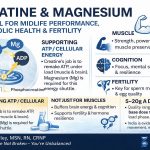
Creatine 101: The ATP Shuttle Your Cells Depend On
Every cell in your body runs on ATP (adenosine triphosphate). The problem is that ATP is expensive to make and gets used up in milliseconds during high-demand work—lifting a weight, firing a neuron, or making a hormone.
Creatine’s job is simple and powerful:
-
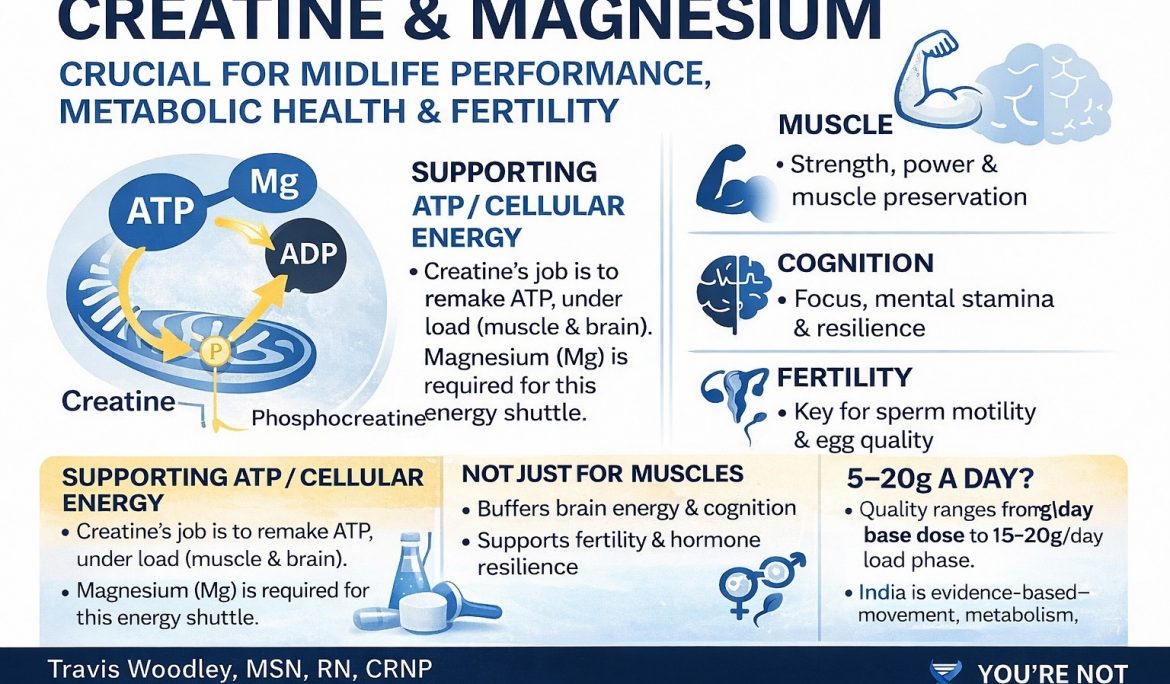
Creatine + phosphate = phosphocreatine (PCr).
-
PCr acts as a rapid-response battery.
-
When ATP is burned and becomes ADP (adenosine diphosphate), phosphocreatine donates its phosphate back → regenerates ATP on the spot.
This creatine–phosphocreatine system sits right where the action is: at the muscle fiber, at the neuron, at the sperm tail, in ovarian tissue, and in other high-demand organs.
If creatine stores are low, you have:
-
Slower ATP regeneration
-
Earlier fatigue
-
Less power output
-
Lower resilience under cognitive or physical stress
You can “eat clean,” train hard, and sleep reasonably well—if this ATP shuttle is under-fueled, you are still running uphill.
Why Magnesium Matters Just as Much as Creatine
Creatine only works inside a bigger energy system. Magnesium is a critical cofactor in that system.
-
ATP in the body is really Mg-ATP. Magnesium stabilizes ATP and allows enzymes to actually use it.
-
Magnesium is involved in the creatine kinase reaction—the enzyme that moves phosphate between creatine, phosphocreatine, ATP, and ADP.
-
Low magnesium = sluggish ATP turnover, muscle cramps, poor sleep, higher stress reactivity.
If you load creatine into a magnesium-deficient system, you’ve upgraded the batteries but left the wiring and switches half-functional.
In practice, that means:
-
I rarely recommend creatine without also addressing magnesium status (diet + supplementation when appropriate).
-
Patients who combine the two generally report smoother energy, better sleep quality, fewer cramps, and better training response than with creatine alone.
Creatine and Muscle: Beyond Gym Aesthetics
Yes, creatine increases strength and muscle mass. But for midlife men and women, that’s not about vanity—it’s about metabolic survival.
What creatine does for muscle
-
Improves high-intensity performance. More phosphocreatine means you can produce more force per rep and maintain output across sets.
-
Supports lean mass. Over time, that translates into more muscle fiber recruitment, better training stimulus, and easier maintenance of muscle as hormones fluctuate.
-
Improves recovery. Faster ATP regeneration reduces the sense of “being wrecked for days” after hard sessions.
Why this matters for metabolic health
Muscle is not just tissue; it is your primary glucose sink and a major endocrine organ. More and better-functioning muscle means:
-
Better insulin sensitivity
-
Lower visceral fat over time
-
Higher resting metabolic rate
-
More myokines that support brain, gut, and immune function
For midlife patients on hormone replacement or peptides, creatine often acts as the bridge between biochemical optimization and real-world strength and function.
Creatine and Cognition: Fuel for Your Frontal Lobe
Your brain is a power hog. It accounts for ~2% of body weight and can use up to 20% of resting energy. Under stress, sleep loss, or high cognitive load, that demand spikes.
Neurons rely on the same creatine–phosphocreatine system as muscle:
-
Regions with high firing rates—like the prefrontal cortex and hippocampus—stockpile creatine to buffer ATP.
-
When creatine is low, neurons have less margin for sustained focus, working memory, and stress resilience.
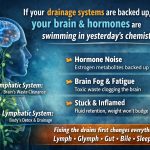
Clinically, when creatine is dialed in (alongside sleep, hormones, and glymphatic/lymphatic drainage), I see:
-
Better word-finding and recall
-
Less “afternoon brain fade”
-
Improved response to stress and decision fatigue
Creatine won’t rescue a wrecked lifestyle, but in a reasonably tuned system it can be the difference between “I’m getting by” and “I can think clearly all day.”
Creatine and Fertility: The Quiet Energy Problem
Fertility is energy-intensive work for both sexes.
-
In women, oocytes and ovarian tissue rely on phosphocreatine to handle the metabolic spikes around ovulation and early embryonic development.
-
In men, sperm are tiny ATP machines. Motility, DNA integrity, and the ability to actually reach the egg are all tightly tied to mitochondrial and creatine function.
If ATP recycling is sluggish, you can see:
-
Lower sperm motility and quality
-
More fatigue and stress around cycles
-
Increased vulnerability to oxidative damage in reproductive tissues
Creatine is not a standalone fertility treatment, but when we’re working on hormones, metabolic health, and inflammation, correcting creatine and magnesium status is part of the foundation.
How Much Creatine? Why 5–20 Grams Can All Be “Right”
Dosing should match body size, training demand, and clinical goals.
Typical ranges I use in practice
-
5 g/day
-
Solid baseline for most adults
-
Good starting point for midlife patients working on strength, cognition, and metabolic health
-
-
10 g/day
-
Often used for larger individuals, heavy training blocks, or patients under higher stress loads
-
Common split: 5 g morning, 5 g post-training or evening
-
-
15–20 g/day (short term, strategic use)
-
Sometimes used for a brief “loading” phase or when correcting an obvious deficit in a larger body
-
I only use higher dosing when digestion, hydration, kidney function, and magnesium are all in a good place—and always with clinical context.
-
Most people don’t need fancy loading protocols. Consistency beats intensity. Daily creatine with adequate magnesium, hydration, and protein does more over months than heroic doses for a week.
Practical Creatine + Magnesium Strategy
This is the kind of framework I use when weaving creatine into a broader hormone and metabolic plan:
-
Check the basics first
-
Kidney function, hydration habits, digestion, bowel regularity
-
Sleep, stress load, training status
-
Medication list and existing supplement stack
-
-
Magnesium first, or at least in parallel
-
Emphasize leafy greens, nuts/seeds, quality protein
-
Often add a well-absorbed magnesium (glycinate, malate, or a blend) in the 200–400 mg range, individualized for bowel tolerance and sleep goals
-
-
Start creatine at 3–5 g/day
-
Usually plain creatine monohydrate
-
Mix in water or with a meal; no need for sugar bombs
-
Watch for GI tolerance and adjust timing or dose as needed
-
-
Adjust based on response and goals
-
More intense strength or power goals → may move toward 7–10 g/day
-
More cognitive or fertility-focused plans → keep dose moderate but steady and extend the time horizon
-
-
Integrate with hormones, gut, and sleep work
-
Creatine works best when thyroid, sex hormones, cortisol, and gut health are being addressed—not in isolation.
-
In my world, creatine is part of a larger protocol that includes hormone optimization, gut repair, lymph/glymphatic support, and sleep rebuilding.
-
Where Creatine Fits in the Bigger Picture
Creatine is not a magic powder. It is a missing piece of basic cell physiology that modern life has outpaced.
If you’re in midlife and experiencing:
-
Fatigue that doesn’t match your labs
-
Brain fog and slow recall under stress
-
Weak training response despite effort
-
Fertility struggles alongside metabolic issues
…then creatine and magnesium often deserve a seat at the table—right alongside work on hormones, gut health, bile flow, sleep, and nervous-system tone.
This is the kind of integrated, systems-level work I lay out in You’re Not Broken – You’re Unbalanced and what we walk through inside Rebuild Metabolic Health Institute:
Not random “biohacks,” but rebuilding the underlying engines—mitochondria, hormones, gut, lymph/glymphatic flow, and energy signaling—so your body can finally match the life you’re trying to live.
If you’re curious where creatine, magnesium, and hormone optimization fit in your specific case, that’s exactly the kind of work we do every cohort.
Learn More & Go Deeper
-
Purchase You’re Not Broken – You’re Unbalanced on Amazon:
https://www.amazon.com/Youre-Not-Broken-Youre-Unbalanced-rebuilding/dp/B0FQJNQ6XP/ref=tmm_pap_swatch_0 -
Find the book on multiple platforms:
https://books2read.com/Youre-not-broken -
Explore resources, articles, and newsletter:
https://rebuildmetabolichealth.com/ -
Instagram: https://www.instagram.com/yourenotbrokenofficial/#
-
Subscribe to my LinkedIn newsletter:
https://www.linkedin.com/build-relation/newsletter-follow?entityUrn=7385386886221074432